Putty Knife Set 4-Piece – Rounded-Edge Wall Repair Tools Safe Around Children and Pets
Putty Knife Set 4-Piece – Rounded-Edge Wall Repair Tools Safe Around Children and Pets
Couldn't load pickup availability
Why you'll love it
- Four included sizes cover everything from detail taping to broad plastering in one purchase
- Stainless steel blade resists rust and corrosion for long-term tool life
- Ergonomic rubber-and-plastic handle reduces hand fatigue during extended scraping sessions
- One-piece blade-and-handle construction prevents the wobble and breakage common in cheaper knives
- Versatile enough to replace multiple single-purpose tools in a homeowner's toolbox
Perfect for
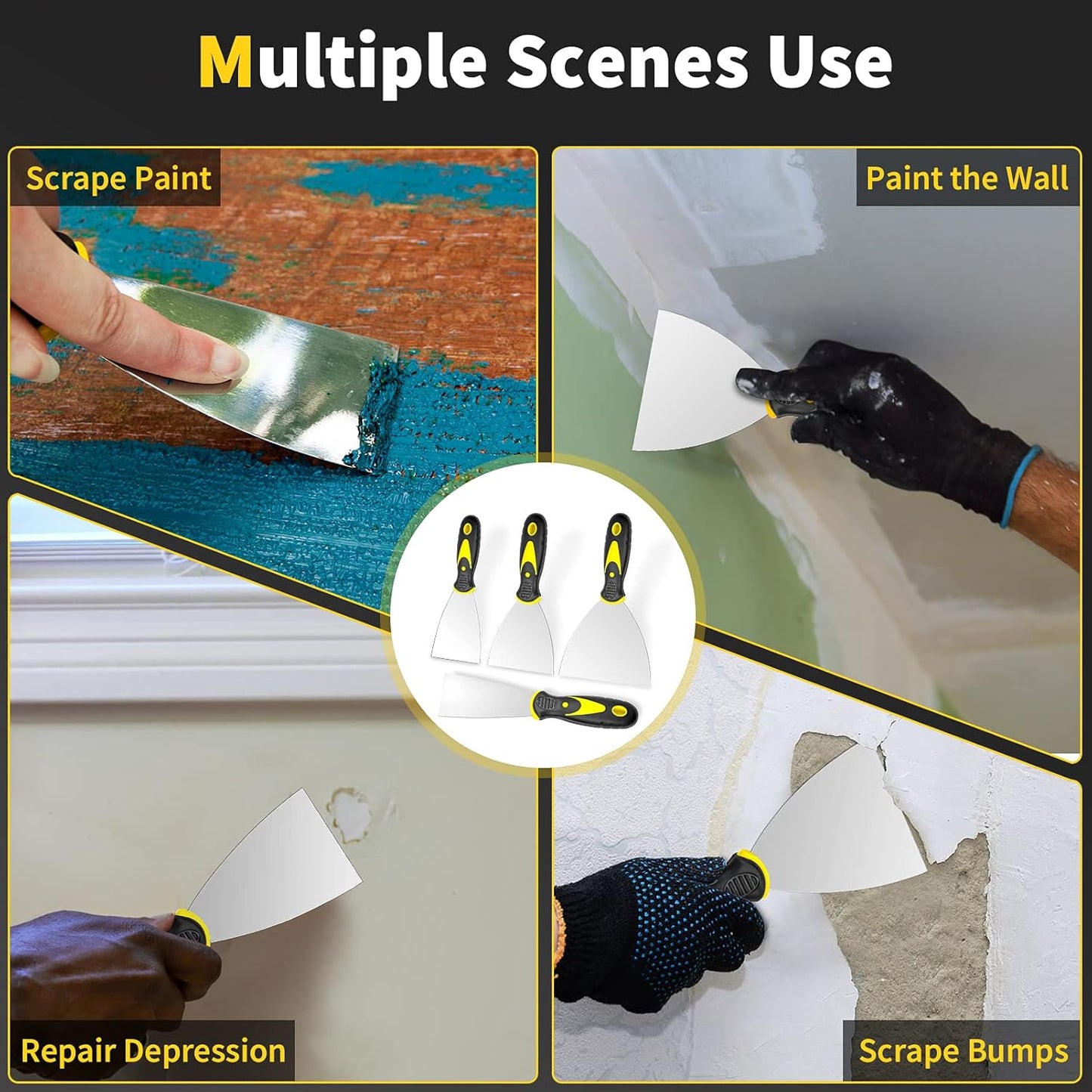
- Patching and repairing cracks in drywall and ceiling
- Spreading putty, plaster, and joint compound on wall seams
- Scraping and removing old wallpaper, paint, and adhesive residue
- Applying drywall tape and adhesives on small repair jobs
- Filling holes in ceramic tile and concrete surfaces

-

Growing up watching my father, a painter, hone his craft over 30 years in our garage, our putty knives embody his motto: “Do one thing, do it right.” Designed in Texas, they’re built for durability, precision, and reliability.
We celebrate garage culture—self-reliance, grit, and local innovation. For pros and DIYers who value honest, purposeful tools.
More than a tool—it’s for those who build and repair the world with their own two hands.
-

The craftsman who started it all.
-

Where every great project begins.


Product Information
Sturdy Design: The blade and handle in our drywall knife are processed in one piece, which is very sturdy. Stainless steel blade has superior load-bearing performance for a long time to use Comfortable Grip: The handle part is a perfect combination of soft rubber and plastic, and using an ergonomic design. Our putty scraper tool makes full use of the elasticity of rubber to make you hold comfortably Anti-Rust Quality: Compared with carbon steel material, our stainless steel spackle knife tool is far stronger in terms of corrosion resistance. The rust-free blade makes you more enjoyable to work in home improvement jobs Various Sizes: Our joint knife covers four sizes of width, 2", 3", 4", 5". The small size is suitable for applying adhesives, and drywall tape. The large size is ideal for applying putty, plaster, and other home improvement materials Widely Apllication: It’s more effortless to apply putty, plaster, cement, and concrete with a putty knife scraper. You can repair and fill the cracks in drywall, ceiling, ceramic tile. In addition, it's perfect for removing paint, sticky objects, and wallpaper
Material Stainless Steel blade + Rubber handle Brand Beyotool Handle Material Rubber Product Dimensions 5"L x 2"W Manufacturer Beyotool UPC 300692641902 Item Weight 0.35 Kilograms Part Number Beyotool-putty Item Weight 12.3 ounces Item model number Beyotool-putty Size 2,3,4,5in Finish Mirror polished Included Components 2in, 3in, 4in, 5in putty knife Batteries Required? No
Frequently Asked Questions
Are the blade edges safe to handle when the set is left out where children might reach it?
The blade edges are working edges and are not child-safe, so the set should be stored out of reach just like any cutting tool. However, the smooth mirror-polished sides and rounded handle geometry mean there are no sharp protrusions or pinch points, and the rubber grip prevents the knife from sliding off a workbench into a child's hands, which is a meaningful safety improvement over slick plastic-handle knives.
Can the soft-rubber handle prevent the knife from slipping out of my wet or gloved hand during a ceiling repair?
Yes, the soft-rubber over hard-plastic handle is specifically engineered to maintain grip when hands are wet, dusty, or covered in compound. The harder plastic core provides structure, while the textured rubber outer layer adds the friction that keeps the knife from spinning or sliding, which is the most common cause of accidental slips and dropped blades during overhead work.
Is the one-piece construction safer than two-piece putty knives that can come apart mid-scraping?
The one-piece forged construction is significantly safer. Two-piece knives can loosen at the rivet or tang, and a handle that separates mid-scrape can send the blade flying or drive it into your other hand. The single-piece design eliminates that failure mode entirely, which is the safety feature professional finishers most often cite when they switch to this style of knife.
Will the lightweight 12.3-ounce total weight reduce the strain on my wrists and elbows compared to heavier all-steel knives?
Yes, the lighter weight reduces the cumulative load on your tendons and joints, especially during overhead ceiling work or long scraping sessions. Heavier all-steel knives transfer every ounce of force into your wrist and elbow, and that repeated load is a common source of repetitive strain. This set keeps enough heft for control while cutting the fatigue that leads to sloppy, unsafe movements late in a job.
Are there any coatings or finishes on the blades that could flake off and contaminate the area where I am working?
No, the blades are bare stainless steel with a mirror polish and have no paint, lacquer, or anti-stick coating that could chip into your joint compound or onto a wall. The finish is the result of mechanical polishing rather than a topical coating, so even after heavy use the surface continues to be food-safe and wall-safe, which matters in kitchens, nurseries, and other sensitive areas.
I have arthritis. Will the ergonomic handle actually be easier on my hands than my old putty knife?
Users with arthritis consistently report that the soft-rubber grip reduces the squeezing force needed to control the knife, and the slightly larger handle diameter is easier to wrap arthritic fingers around than a thin all-metal handle. The lighter total weight also means less force is needed to hold the knife steady, which together makes a real difference during a longer patching session.
Is there any risk of the blade snapping while I am prying off old wallpaper or tile?
The one-piece forged construction makes blade snap-through highly unlikely under normal scraping and prying loads. The stainless steel has enough flex to absorb prying forces without cracking, and because the handle is part of the same piece of metal, there is no joint to fail. You should still avoid using the knife as a pry bar on tile, but for its intended scraping and patching work, blade failure is not a realistic concern.
Will the stainless steel blades cause sparks if they accidentally scrape against a hidden nail or metal lath in the wall?
Stainless steel can produce a brief spark when scraped against hardened metal, but the sparks are minimal and short-lived, far less than those produced by grinding or cutting. For typical residential drywall and plaster work, the risk of igniting anything behind the wall is negligible. If you are working in an environment with flammable vapors, follow standard spark-prevention practices, but for normal home repair this is not a meaningful hazard.
Can I use this set safely in a nursery or child's bedroom where I am concerned about chemical off-gassing from tools?
The stainless steel and rubber-and-plastic handle do not off-gas the way some coated or painted tools can, and there is no oil finish that needs to wear off before the knife is safe to use in a living space. Wipe the blades with a damp cloth before first use to remove any polishing residue, and the set is safe to bring into a nursery, bedroom, or other occupied room without ventilation concerns.
What happens if the knife falls off a ladder or scaffold while I am working overhead?
The one-piece construction means the knife will not break apart on impact, but it is still a hard metal object, so you should never work directly above another person. The mirror-polished finish also makes the knife easy to spot if it lands in debris, and the rubber handle keeps the knife from bouncing unpredictably the way a slick all-metal handle can. For overhead work, tethering the knife to your belt or wrist is the safest practice with any hand tool.
How does this set compare to a cheap two-piece putty knife in terms of safety?
Cheap two-piece putty knives fail in several safety-relevant ways: the rivet loosens, the handle spins, the blade can detach, and the carbon steel rusts into a rough surface that can scratch skin. This set addresses every one of those failure modes with one-piece construction, a non-slip rubber grip, and stainless steel, so the comparison in day-to-day safety is substantial, not just incremental.
Is this set safer for a first-time DIYer than borrowing random old putty knives from a relative?
Yes, and for a clear reason. Old, rusty, or loose-handle putty knives are a common source of cuts, splinters, and tetanus concerns. Starting with a new stainless set means clean, sharp but smooth edges, a tight one-piece handle, and no hidden corrosion, which is the safest possible introduction to patching and scraping work for a beginner.
I worry about dropping a knife while leaning over a bathtub or stairwell. Will the rubber grip help?
The rubber grip is the most important safety feature in that scenario because it dramatically increases the coefficient of friction between your hand and the handle. A wet or chalky hand on a slick plastic or wood handle is the typical cause of a dropped blade over a tub or stair edge. The soft-rubber over hard-plastic grip is specifically designed to stay put under those exact conditions.
What is the best way to clean putty knives after using them with joint compound?
Wipe the blade clean with a damp cloth or rag before the compound dries, then rinse under warm water and dry thoroughly. For dried compound, soak the blade in warm water for a few minutes and the residue will scrape off easily with your fingernail or a second knife. Because the blades are stainless steel, you can also use a mild dish soap without worrying about corrosion.
Can I use these putty knives to apply wood filler on furniture, or are they only for drywall?
You can absolutely use these knives for wood filler, and many DIYers keep the same set for both drywall and furniture work. The flexible stainless steel blade lays wood filler smoothly across grain, and the narrower 2-inch size is ideal for filling nail holes and small cracks in trim. Just wipe the blade clean before switching back to drywall compound to avoid cross-contamination of colors.
What is the correct order of blade widths to use when finishing a drywall seam?
The standard professional order is to start with the 2-inch or 3-inch blade to press drywall tape into the first coat of compound, then move to the 4-inch blade for the second coat that feathers out 4 to 6 inches beyond the seam, and finish with the 5-inch blade for the final skim coat that blends the repair into the surrounding wall. This graduated approach produces a flat, invisible seam with minimal sanding.
Will these knives work with premixed joint compound, or do I need to mix my own from powder?
They work with both premixed and powder-mixed joint compound, and the choice depends on your preference and project size. Premixed compound is more convenient for small patch jobs and opens directly into your mud pan, while powder compound is more economical for large finishing projects. The flexible stainless steel blades handle either consistency equally well.
Are replacement blades available, or do I need to buy a whole new set if one gets damaged?
The blades are integrated into the handles as a one-piece construction, so individual replacement blades are not available. The upside is that one-piece construction is what gives the set its strength and eliminates handle failure, and the stainless steel resists the kind of damage that would force replacement. With reasonable care, the set typically lasts for many years of regular DIY and professional use.
What is included in the box when this putty knife set arrives?
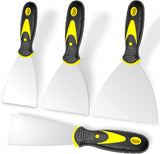
The box includes four putty knives with blade widths of 2 inches, 3 inches, 4 inches, and 5 inches, each with a stainless steel mirror-polished blade and an ergonomic rubber-over-plastic handle. You will need to supply your own joint compound, drywall tape, sandpaper, and a mud pan, all of which are sold separately at any hardware store. No assembly is required; the knives are ready to use straight out of the package.
How do I store the set to keep the blades from dulling or getting damaged?
The safest storage method is to hang the knives on a magnetic strip, a pegboard hook, or a tool roll, with the blades separated so they do not knock against each other. Avoid tossing them loose into a drawer where the edges can contact other metal tools and dull over time. Wiping the blades dry before storage will keep the mirror polish looking new indefinitely.
Is joint compound the same as spackle, and can I use either with this set?
Joint compound and spackle are similar but not identical. Joint compound is designed for larger drywall seams and finishing work, while spackle is formulated for small hole and nail-pop repairs and dries faster with less shrinkage. Both work perfectly with this putty knife set, and the flexible blades handle either material cleanly. For typical homeowner repairs, spackle is usually the more convenient choice.
What is the difference between a putty knife and a joint or taping knife?
A putty knife traditionally has a stiff, narrow blade designed for scraping and prying, while a joint or taping knife has a wider, more flexible blade designed for laying and smoothing joint compound over drywall seams. The knives in this set bridge both uses: the narrower 2-inch and 3-inch blades handle putty and scraping tasks, while the wider 4-inch and 5-inch blades function as joint and taping knives for drywall finishing.