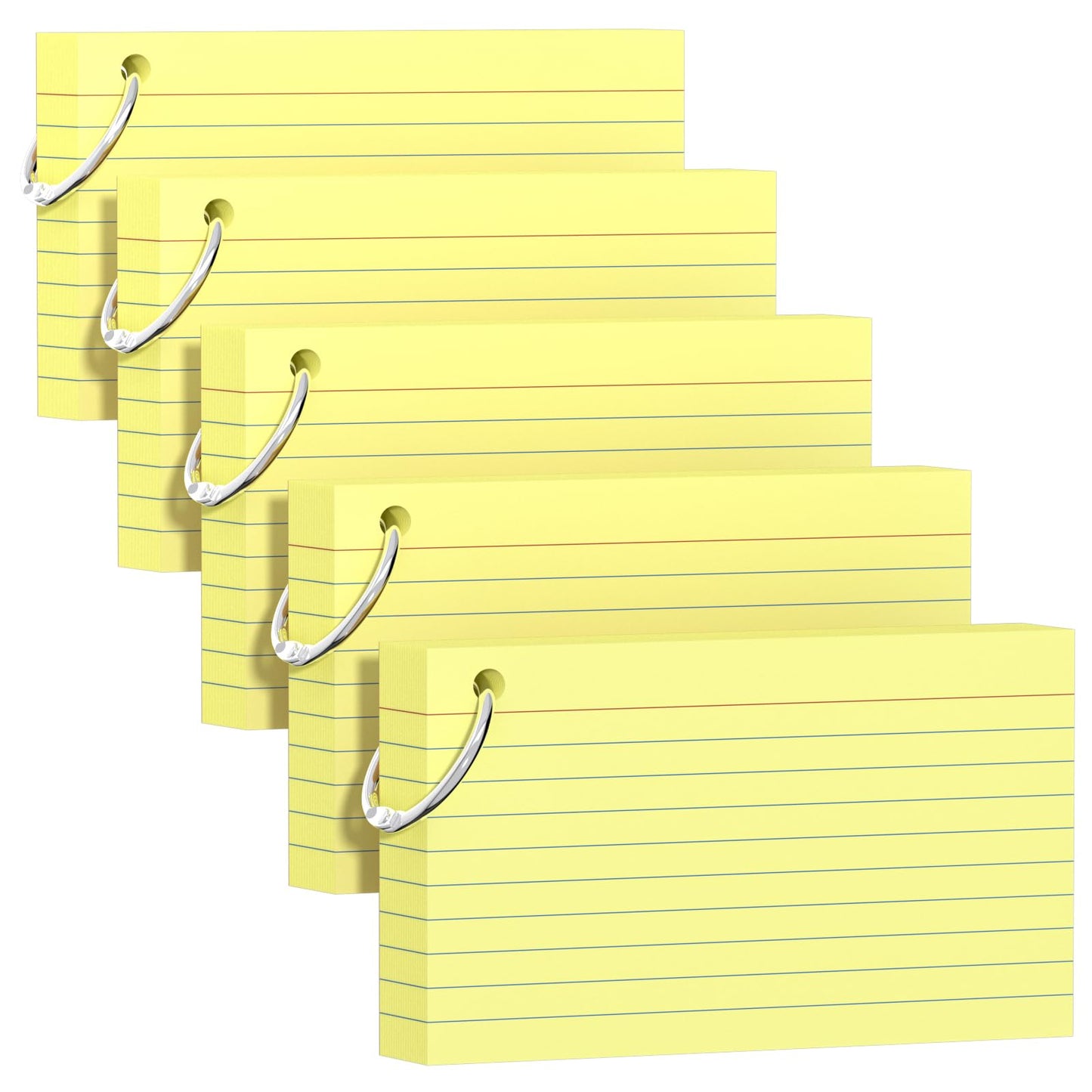
ColorStudy Heavy Weight Index Cards with Key Ring – Printer-Compatible 3x5 Notecards for Work Productivity, 250 Count
ColorStudy Heavy Weight Index Cards with Key Ring – Printer-Compatible 3x5 Notecards for Work Productivity, 250 Count
Couldn't load pickup availability
Why you'll love it
- 180gsm heavy-weight paper resists ink bleed-through unlike flimsy competitors
- Key ring keeps the card stack attached to a backpack or lanyard so notes are never lost
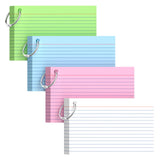
- 5 color assortment enables visual organization by subject, priority, or category
- 250-count bulk pack (50 per color) offers strong value for heavy study or office use
- Color coding makes studying more engaging and improves memory retention
Perfect for
- Color-coded study flashcards for exam prep
- Quick to-do lists and reminders on the go
- Memorization drills with subject-specific color coding
- Portable note-taking attached to a backpack via key ring
- Office memos and brainstorming notes in a multi-color system


Product Information
Premium Thick Paper: 180gsm weight resists bleed-through and withstands frequent handling
Key Ring Design: Perfect for attaching to bags, backpacks, or keys - always have your notes handy
5 Color Assortment: Choose from 5 vibrant colors (purple, blue, green, pink, white) to suit your style and organizational needs
Generous Quantity: 50 sheets per color (totaling 250 cards) provides plenty of space for all your notes
Ideal Size: The 3x5 inch size index card is perfect for quick jotting, to-do lists, flashcards
Material Type: Paper
Color: 5 Multicolor
Compatible Printer Models: All printers that support 3x5 inch paper
Size: 3x5 inch
Item Weight: 0.38 kg
Sheet Count: 50
Item Dimensions L x W: 5"L x 3"W
Frequently Asked Questions
How do these cards help me stay focused during a work or study session?
The 5-color assortment lets you build a quick visual coding system for tasks, priorities, and subject areas, so you can scan a stack and find what you need without flipping through unrelated notes. Combined with the attached key ring, your entire workflow stays in one portable bundle that travels from desk to meeting to home.
Can I use these index cards to build a reliable color-coded to-do system?
Yes. With 50 cards in each of the 5 colors, you can dedicate a color to a category like urgent, follow-up, personal, project A, and project B, and still have hundreds of cards left for long-term use. The 3x5 size slips easily into a pocket or planner pocket so your list is always with you.
Will the heavy 180gsm paper hold up to daily note-taking without bleeding?
The 180gsm weight is significantly heavier than standard index cards, which usually run 60 to 120gsm, so most pens, markers, and highlighters will not bleed through to the other side. This means you can write on both sides of a card and still read both sides clearly, doubling your usable space.
How does the key ring help my office productivity routine?
The integrated key ring keeps your active card stack clipped to a lanyard, badge reel, or bag, so your current project notes and meeting reminders are never left behind in a meeting room. You can flip through them one-handed while walking between meetings, which is faster than reopening a notebook or unlocking a phone.
Is the 250-count pack enough for a full semester of high-volume note-taking?
For most students and office users, 250 cards covers a full term of daily flashcard creation, weekly to-do lists, and ad hoc reminders with cards to spare. If you regularly build large decks, the related 300-count variant offers even more headroom for the same per-card price.
Which productivity setup is this card pack best suited for?
It is designed for users who prefer paper-based task and study systems, especially those who want to color-code by project, priority, or day without relying on a screen. It pairs well with bullet journal, GTD, and Pomodoro workflows where quick capture and visual triage matter.
Can I keep different projects sorted by color on the same ring?
Yes. Many users assign one color per project and slip a small paper tab or clip between stacks to separate them on the ring. This gives you a single portable reference without needing multiple notebooks.
Is the 3x5 size easy to read during quick study bursts?
The 3x5 inch format is large enough for several lines of text or a small diagram, while still being pocket-friendly. It is the most widely used flashcard size, so any standard index card holder or storage box will also fit these cards.
Does the bulk 250 pack offer better value than smaller office stationery sets?
Per-card pricing on a 250-count bulk pack is meaningfully lower than on 50 or 100-count retail packs, and you also get the integrated key ring and heavy stock that competitors usually charge a premium for. For heavy users, the value difference adds up within a single study term.
How do these compare to using a notes app on my phone for productivity?
Paper cards remove notifications, app switching, and battery anxiety, which makes them better for deep focus sessions and exam prep where retention matters. They also let you physically sort, shuffle, and group cards in ways a digital list cannot replicate, which is why many productivity systems still recommend a paper component.
How do these compare to standard white index cards for study use?
Standard white-only cards force you to write labels or use stickers to differentiate subjects, which slows you down. The built-in 5-color system removes that extra step and makes visual scanning instant, which is especially helpful for large flashcard decks.
Are these better than spiral-bound flashcard sets for exam prep?
Spiral-bound sets are fixed in order and cannot be reorganized mid-study. Loose cards on a key ring let you shuffle, remove mastered cards, and reinsert difficult ones, which is the method most memorization research recommends.
Will the paper quality really make a difference, or is 180gsm just marketing?
For users who write with felt-tip pens, gel pens, or highlighters, paper weight is the single biggest factor in bleed-through. At 180gsm, the cards behave closer to a thick notecard than a flimsy drugstore index card, so you get a cleaner writing surface and a stiffer card that does not flop.
I am worried 250 cards will feel overwhelming to start with. Is there a smaller option?
If you want to test the system first, you can simply load 20 to 30 cards onto the key ring and store the rest in the original packaging. The ring only carries what you attach, so the bulk pack does not force you to use everything at once.
Will printer-compatible sizing actually save me time on busy weeks?
Because the 3x5 size is supported by many home and office printers, you can print templates, vocabulary lists, or QR-coded reference cards directly onto the stock instead of writing each one by hand. This is a meaningful time saver during cramming periods or when prepping meeting handouts.
Is there a risk the key ring will pop open and lose my notes?
The key ring is a standard split-ring design that holds firmly once cards are threaded on; it does not spring open on its own. If a card ever feels loose, a gentle squeeze of the ring with two fingers will re-tighten it.
How do I load the index cards onto the key ring when I first open the pack?
Pry the split-ring open slightly with your fingers or a small flat tool, thread the corner of a card through the gap, and slide the card around the ring. Repeat for each card; once several cards are loaded, the stack is stable and the ring stays closed on its own.
How should I store the cards I am not actively using on the ring?
Keep the unused cards in the original packaging or a small box, sorted by color if you want, in a dry location away from direct sunlight. This prevents edge curling and keeps the heavy paper stock looking new for the next time you need it.
Can I print directly onto these index cards from my home printer?
Yes, on any printer that supports 3x5 inch paper. Most modern inkjet and laser printers can be set to 3x5 in the page-size menu, and you can use a 'business card' template to print vocabulary lists, QR codes, or study prompts directly onto the heavy stock.
Will these cards fit standard index card holders, recipe boxes, or filing systems?
Yes. The 3x5 inch size is the most common index card dimension, so the cards fit virtually every standard holder, recipe box, library card file, or rolodex-style organizer on the market. The 4x6 inch variant is also available if you need a larger surface.
What is included in the box when I order this product?
You receive 250 index cards in total, with 50 cards each in purple, blue, green, pink, and white, plus a single metal split-ring already attached. No additional accessories, ink, or pens are included, and the cards are ready to use straight out of the package.
Is the paper acid-free, so my notes will not yellow over time?
The cards are made from quality heavy-weight stock designed for archival-style note storage, so they hold up well to regular handling and resist yellowing under normal indoor conditions. For decades-long storage, keep them in a dry, dark container as you would with any paper product.
Are the colors on the cards safe and non-toxic for everyday handling?
Yes. The cards are produced for general stationery and educational use and are safe for routine handling by adults and children. As with any paper product, avoid contact with food and keep away from open flames.
What is the difference between index cards and regular note cards for studying?
Index cards are a standardized paper size (3x5 or 4x6) designed for flashcards, sorting, and filing, while general note cards are usually thicker cardstock used for invitations or short notes. For active study, sorting, and color-coding workflows, index cards are the right tool because they are uniform, light, and supported by most holders and printers.